
A Ziyanda Capital opinion piece

Table of Contents
Africa needs $130–170 billion per year in infrastructure investment to realise the promise of the world’s largest free trade area.
13 min read · Transport · Energy · Digital · Finance Updated April 2025
Africa stands at a defining moment in its economic history. With the African Continental Free Trade Area (AfCFTA) creating the largest free trade area in the world by number of participating countries, 54 nations with a combined GDP of $10,8 trillion, and a market of 1.7 billion people, the continent has made its most ambitious economic commitment since independence.
Yet one critical question persists: can Africa trade effectively with itself without the infrastructure to support that trade? The answer, backed by mounting evidence, is unambiguous: it cannot. Infrastructure is not a complementary asset to economic growth, it is the foundational prerequisite upon which Africa’s industrialisation, integration, and shared prosperity will be built or broken.
The Infrastructure Gap: Africa’s Binding Constraint
Across the continent, infrastructure deficits remain among the most significant barriers to growth. From degraded road networks and skeletal rail systems to chronically unreliable electricity supply and thin digital connectivity, the challenges are both systemic and widespread, and the data is sobering.
- $100B infrastructure financing gap per annum (African Development Bank);
- 600M Africans without access to electricity (AfDB estimate);
- 53% OF ROADS – Share of African roads that are paved: just 43% of the population has all-season road access;
- 50% ABOVE GLOBAL AVERAGE – Premium on Africa’s trade costs due to infrastructure gaps; United Nations Conference on Trade and Development (UNCTAD) 2024;
- 40% PRICE INFLATION – Transport costs inflate the price of goods by up to 40% (Africa Finance Corporation); and
- 14.9% INTRA-AFRICAN SHARE – Formal intra-African trade as % of total African trade (2023, Afreximbank).
The African Development Bank estimates the continent requires between $130 billion and $170 billion annually in infrastructure investment.
AFRICA’S ANNUAL INFRASTRUCTURE INVESTMENT NEED VS. CURRENT SPEND — USD BILLIONS

Sources: Africa Finance Corporation – State of Africa’s Infrastructure Report 2025
The current financing gap is estimated at approximately $100 billion per year, a shortfall that has persisted for decades while the population and its needs continue to grow. At the current pace of investment, sub-Saharan Africa would only meet its Sustainable Development Goal infrastructure targets in the year 2117, according to analysis of UNCTAD data.
Transport costs are particularly crippling. Poor connectivity means road transportation accounts for approximately 29% of the price of goods traded in Africa, compared to just 7% for goods traded outside the continent, a structural competitiveness penalty embedded in every transaction.
KEY CONSTRAINT AREAS
Transport inefficiencies dominate the cost of doing business. With 80% of goods and 90% of passenger traffic moving by road, and more than 60,000 km of critical road links requiring urgent upgrading to accommodate AfCFTA freight growth, the transport deficit is the continent’s most immediate trade barrier. Upgrading those road links alone would cost, at the very least, $24 billion.
Energy shortages undercut industrial productivity across the continent. Africa added just 6.5 GW of utility-scale energy capacity in 2024, which when compared to India’s 18 GW in renewables and the United States’ 48.6 GW, looks insignificant. Closing Africa’s energy gap requires approximately $190 billion annually, amount to approximately 6% of GDP, yet less than half of all Africans have reliable electricity access.
Digital infrastructure gaps constrain modern commerce. While 87% of people in Sub-Saharan Africa live within an area with mobile broadband coverage, 40% still lack connectivity due to digital literacy barriers, handset costs, and unaffordable data, limiting access to e-commerce, digital payments, and modern customs systems.
Water and logistics systems remain insufficient to support the scale of agriculture and manufacturing that AfCFTA envisions. Investment needs for roads account for 32% of total requirements, railways 24%, fibre-optic cables 23%, and solar power 17%, according to OECD analysis.
The State of Africa’s Infrastructure: A Spatial Overview
Infrastructure development across Africa is highly uneven. Northern and Southern Africa are significantly better connected than the interior of the continent, while landlocked states, particularly in Central and West Africa, face the most severe constraints on trade and economic participation.
Infrastructure Development as Economic Stimulus: The Multiplier Case
Infrastructure development is one of the most powerful tools for economic stimulus available to any government or development institution. Its impact is simultaneously immediate, this through job creation and construction activity, and long-term, through the productivity gains and investment flows it unlocks over decades.
👷 Direct Job Creation
Large-scale projects create millions of direct and indirect roles, construction, engineering, supply chains, and ongoing operations and maintenance.
🏭 Enablement of Industrial Development Programmes
Reliable energy and transport unlock manufacturing, agro-processing, and mining at scale, the foundation of structural economic transformation.
💰Attraction of Investments
Investors commit capital where infrastructure reduces operational risk. World Bank modelling projects FDI into Africa could rise by 159% under full AfCFTA implementation.
📦 Productivity Gains
Lower transaction costs, shorter delivery times and improved market access cascade through every sector, compounding returns over time.
📈 GDP and/or Economic Multiplier
ISS (Institute of Security Studies) Africa modelling shows the Leapfrogging Infrastructure scenario could make Africa’s economy $600 billion larger by 2043, which is 7.1% above current-path forecasts.
The ISS Africa modelling of is particularly instructive.
If Africa were to spend an additional $77.9 billion (2017 USD) in infrastructure development projects, such investment or capital spend would boost Africa’s GDP growth rate to 5,6% per annum by 2043. To put it into context, the $77,9 billion additional spend represents an economic stimulus package that could deliver an additional 310,000 jobs as well as a GDP measure of $377 per capita.
A Market Awakening: The Rise of Intra-African Trade
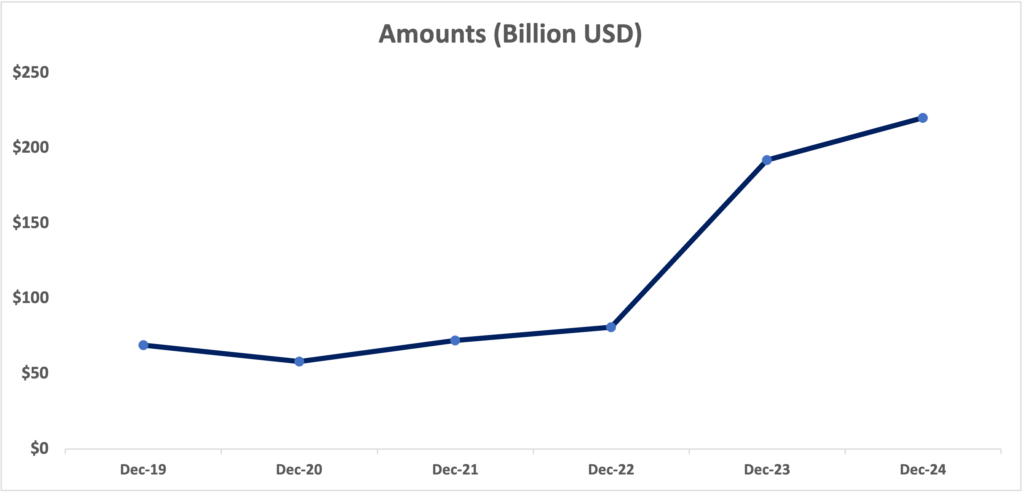
Sources: Afreximbank Africa Trade Report 2024; One Africa Markets 2025; Brookings Institution
If Africa builds the infrastructure, trade will follow. And where trade flows, prosperity grows.
CENTRAL THESIS: AFCFTA INFRASTRUCTURE IMPERATIVE
Between 2019 and 2024, intra-African trade tells a compelling story of both constraint and breakthrough. In 2019, trade across the continent stood at approximately $70 billion, a modest figure reflecting fragmented markets and deep structural barriers. The dip to around $58 billion in 2020, driven by the COVID-19 pandemic, exposed the fragility of Africa’s internal trade systems and the extent to which the movement of goods depended on inefficient infrastructure.
Recovery began gradually. By 2021 and 2022, trade activities climbed back to roughly $75 billion and $85 billion respectively, supported in part by the early implementation of the African Continental Free Trade Area. Yet growth remained constrained, highlighting a critical reality: policy reform alone cannot drive trade without the infrastructure to support it.
The real shift came between 2022 and 2024. Intra-African trade surged dramatically to nearly $195 billion in 2023, reaching approximately $220 billion in 2024. This rapid acceleration reflects more than policy alignment—it signals the early impact of improving transport corridors, more efficient border systems and better logistics networks. For the first time, trade policy and infrastructure began to work in tandem.
The lesson is clear: as infrastructure improves, trade responds. Reduced transit times, lower costs and greater connectivity are enabling African businesses to access regional markets at scale, transforming fragmented economies into an increasingly integrated continental market.
If this trajectory continues, the full potential of the African Continental Free Trade Area will be realised not just in agreements, but in tangible economic activity across borders.
Trade is not just negotiated – it is transported.
AfCFTA: A Historic Vision Dependent on Infrastructure
The African Continental Free Trade Area, which entered into force in January 2021, represents Africa’s most ambitious economic policy commitment since the Organisation of African Unity was formed in 1963. Its goals are transformative: eliminating tariffs on 90% of goods over a period of five to ten years, facilitating the movement of capital and people, and fundamentally reorienting African trade from external commodity dependence toward intra-continental exchange.
Early results are encouraging. Intra-African trade reached $220.3 billion in 2024, a 12.4% increase year on year, driven in part by AfCFTA’s early impact. Thirty-seven of 54 member states had submitted their tariff schedules by October 2024. The Pan-African Payment and Settlement System is operational. The Guided Trade Initiative, which began with seven countries in 2022, has expanded to cover 37 member states.
Yet the structural barriers that infrastructure deficits create remain formidable. Non-tariff barriers restrict African trade three times more than tariffs themselves, and poor physical connectivity is the root cause of the majority of these trade barriers. Road transport already accounts for 29% of the price of goods traded in Africa, a figure that tariff elimination alone cannot move.
INFRASTRUCTURE ENABLES AFCFTA IN THREE CRITICAL WAYS
Trade corridors connect landlocked countries to ports, reducing transit time and cost and unlocking the interior of the continent. UNECA analysis estimates AfCFTA could generate a 28% increase in intra-African freight demand by 2030, which is demand that the current or the existing infrastructure cannot service.
Energy integration through cross-border transmission lines and regional power pools supports industrial hubs and regional value chains. Africa’s five regional power pools, namely (i) NAPP, (ii) WAPP, (iii) CAPP, (iv) EAPP, and (v) SAPP, are functional but significantly underpowered.
Building integrated African grids is, as the AFC 2025 report concludes, “no longer aspirational, it is essential.”
Digital platforms enable e-commerce, customs efficiency and financial integration at scale. Digital trade is projected to surpass $180 billion, with fintech and e-logistics as major drivers, but this requires backbone fibre infrastructure that currently reaches only a fraction of the continent.
Priority Infrastructure for Africa’s Integration
Not all infrastructure investment is equal in its impact on continental integration. To unlock the full potential of AfCFTA, Africa must prioritise strategically across four interconnected domains, and critically, these investments must be coordinated regionally, not just nationally.
1. TRANSPORT CORRIDORS
Regional highways and rail networks form the physical arteries of trade.
The Lobito Corridor, connecting Angola’s Port of Lobito to Zambia’s Copperbelt through the Democratic Republic of Congo, is the continent’s most high-profile current project, with the Africa Finance Corporation signing concession agreements with Angola and Zambia for a 485-mile (approximately 781 kilometres) rail line.
Port expansion and modernisation is equally urgent: Africa is entering a third wave of port privatisation, but new port capacity must be matched by improved connecting road and rail networks (especially those networks connecting the hinterlands).
2. ENERGY INFRASTRUCTURE
Power generation, particularly renewables, where Africa holds extraordinary natural advantage, combined with regional transmission infrastructure, is critical. Africa must double or triple its annual energy buildout to meet development goals.
The Grand Inga hydropower project in the DRC (4.8 GW at phase III) remains a transformational opportunity, though it has been delayed to 2030 at the earliest.
Solar energy represents the most cost-effective near-term pathway, accounting for 17% of total investment needs identified by OECD.
3. DIGITAL INFRASTRUCTURE
Broadband expansion, establishment of data centres and the development of digital identity systems form part of the infrastructure of the 21st century economy.
Open RAN architecture, which enables interoperability of equipment from multiple vendors, is already being deployed in Nigeria, this on the back of local currency financing, reducing costs and reaching underserved communities.
Closing the digital gap requires both physical infrastructure and innovative financing structures to make connectivity economically accessible.
4. URBAN AND INDUSTRIAL ZONES
Special Economic Zones (SEZs), logistics hubs and industrial parks create the concentrated demand that justifies and anchors surrounding infrastructure investment. They provide the manufacturing and processing capacity that transforms Africa’s raw material wealth into value-added goods, the structural shift AfCFTA is designed to accelerate.
INFRASTRUCTURE INVESTMENT NEEDS BY SECTOR — SHARE OF TOTAL (OECD 2025)

Source: OECD Africa’s Development Dynamics 2025
NB. Infrastructure maintenance makes up 42% of total investment needs. Rehabilitation of existing assets is as important as new builds.
Financing the Future: A Call to Action
Africa’s infrastructure challenge is not merely a question of need; it is a question of financing architecture and execution capacity.
The financing gap related to Africa’s infrastructure investment requirements is real, but so is the capital available. Africa already holds over $1.1 trillion in domestic capital, from pension and insurance funds to public development banks and sovereign wealth funds. All of this $1,1 trillion is capital that is currently not being mobilised at scale for infrastructure investment.
Traditional financing channels are under pressure. Bilateral donors reduced disbursements from a peak of over $7 billion in 2018 to just $4.4 billion in 2023. China’s Belt and Road Initiative infrastructure investment has declined significantly since its 2016 peak. FDI flows to Africa have been volatile.
The paradigm needs to shift.
KEY FINANCING SOLUTIONS
Public-private partnerships (PPPs) remain the primary vehicle for mobilising private capital at scale, but only when government frameworks create genuinely bankable projects with appropriate risk allocation. Governments must minimise investor risk without over-restricting private sector participation.
Development finance institutions (DFIs) such as the African Development Bank (which has invested more than $44 billion over seven years in corridors, ports, railways and regional power pools) play a catalytic role, de-risking investments that would otherwise be unfinanceable commercially.
Domestic institutional capital from pension funds and sovereign wealth funds represents the most underutilised resource. With the right regulatory frameworks and project structures, this capital can be directed toward the long-duration, stable-return infrastructure investments that African pension funds, in particular, should naturally seek.
Blended finance structures, combining concessional development finance with commercial capital, can bridge the gap between project risk profiles and commercial return requirements, unlocking investments that neither sector would make alone.
Local currency financing addresses a fundamental vulnerability of African infrastructure projects: currency mismatch between local currency revenues and US dollar denominated debt service. The Nigerian ISP model, using Naira-based financing secured by a USTDA (United States Trade and Development Agency) feasibility study, demonstrates that innovative local-currency structures can circumvent dollar shortage constraints and make projects viable.
Critically, there is a growing imperative for African-led capital mobilisation. The continent must retain ownership and long-term value from its infrastructure assets, not merely serve as a destination for external capital extracting returns.
Building the Backbone of Prosperity
Africa’s future will not be defined by policy frameworks alone. The future of Africa will be built physically and digitally, this through the systems that connect its people, markets, and industries. The African Continental Free Trade Area (“AfCTA”) is the policy vision. Infrastructure is the execution mechanism.
The arithmetic is clear: $130 billion to $170 billion is needed annually, where $100 billion still to be found each year. Yet $1.1 trillion in domestic capital is sitting unmobilised.
This is not a trivial state. When this is taken in the context of a continent of 1.7 billion people whose economic potential is being held back by the absence of roads, power lines, rail links and optic fibre cables, the picture needs to scare those in policy-making decisions, as well as to galvanise those who have the ability to structure, arrange and raise capital for infrastructure development programmes.
Infrastructure is the backbone of economic transformation, industrialisation, regional integration and global competitiveness. AfCFTA presents a historic opportunity, but without infrastructure, it risks becoming the continent’s most ambitious, yet underutilised vision.
If Africa builds the infrastructure, trade will follow. And where trade flows, prosperity grows.
Frequently Asked Questions
How much does Africa need to invest in infrastructure annually?
The African Development Bank estimates Africa requires between $130 billion and $170 billion annually in infrastructure investment. The current financing gap stands at approximately $100 billion per year, as African governments currently spend around $34 billion on an annual basis on infrastructure development, which roughly amounts to 1,3% of GDP. Ziyanda Capital argues that we need to do more.
What is the current level of intra-African trade?
Intra-African trade reached $220.3 billion in 2024, representing a 12.4% year-on-year growth. Formal intra-African trade accounted for approximately 14.9% of total African trade in 2023, though when informal cross-border trade is included, the real figure may be closer to 40%. Africa needs to develop its infrastructure to the point of capturing all the informal trade, so that the true economic value of Africa can be known. At Ziyanda Capital, our argument is that “one cannot improve what one does not measure”.
Why does infrastructure matter for AfCFTA implementation?
Infrastructure gaps in transport, energy and digital connectivity drive African trade costs to approximately 50% above the global average. Non-tariff barriers, primarily those created by poor physical connectivity, restrict African trade three times more than tariffs themselves.
Without infrastructure, reduced tariffs under AfCFTA cannot lower logistics costs, and trade agreements alone cannot overcome physical barriers between markets.
Trade agreements, in our view, need to be preceded by, or at the very least, followed by inter-regional or inter-continental infrastructure development pacts or treaties. The same as peace-keeping missions: they need to be followed by infrastructure development agreements.
How much electricity capacity does Africa add each year?
In 2024, Africa added over 6.5 GW (6,500 Megawatts) of utility-scale electricity capacity. This compares to 18 GW added by India in renewables alone and 48.6 GW added by the United States in the same year.
Africa needs to double or triple its annual energy buildout to meet development goals, which investment requires approximately $190 billion annually, which is approximately 6% of GDP.
Considering the capital that the African continent sits with, this $190 billion can be raised from the domestic markets of the African continent.
What are Africa’s priority infrastructure investment areas?
According to the OECD Africa’s Development Dynamics 2025 report, Africa’s infrastructure investment needs are concentrated in roads (32% of total), railways (24%), fibre-optic cables (23%), and solar power (17%).
Infrastructure maintenance represents 42% of total investment needs, making rehabilitation of existing assets as important as new construction. When Africa considers investment in infrastructure, policy-makers need to think beyond new builds: (i) what do we do with the current infrastructure? (ii) which part do we rehabilitate and which part do we mothball and replace?
KEY SOURCES & FURTHER READING
- Africa Finance Corporation – State of Africa’s Infrastructure Report 2025;
- African Development Bank – Cross-Border Road Corridors Report 2023;
- OECD – Africa’s Development Dynamics 2025: Infrastructure & Productive Transformation;
- UNCTAD – Economic Development in Africa Report 2024;
- Afreximbank – Africa Trade Report 2024;
- Brookings Institution – Reaping the Benefits of the AfCFTA: Transport Services and Infrastructure (March 2025) – https://www.brookings.edu/articles/reaping-the-benefits-of-the-afcfta-strengthening-transport-services-and-infrastructure-for-growth/;
- Wilson Centre – Addressing Africa’s Infrastructure Gap Through Innovations in Finance and Technology (January 2025) – https://www.wilsoncenter.org/article/addressing-africas-infrastructure-gap-through-innovations-finance-and-technology;
- ISS Africa Futures – Africa Large Infrastructure Futures – https://issafrica.org/themes/search?themes%5B%5D=4f2ad0be-d657-4f8a-bb85-322f80de51be; and
- Control Risks – Hard Infrastructure Investment in Africa Still Dragging its Feet (https://www.controlrisks.com/our-thinking/insights/hard-infrastructure-investment-in-africa-still-dragging-its-feet).
Let’s discuss how we assist you with your project.